
On 21 March 1960, police in South Africa gunned down 69 unarmed Black South African people protesting against the pass laws in an event that became knows as the Sharpeville massacre.
Six years later, the United Nations created the International Day for the Elimination of Racial Discrimination on that date.
In 1998, Australian Prime Minister commissioned the Eureka Research to begin an anti-racism study to “explore and understand the subtleties and nature of racism in the Australia of the late 1990s, with a view to mounting an effective mass media and/or education anti-racism campaign”.
Among the conclusions of the study were that there was a need for an anti-racism campaign and a promotion of “living in harmony”. According to multiple media reports, the outcomes of the research were not aligned with the government’s views that Australians were not racist. Commenting on the racially-motivated 2005 Cronulla riots, he stated: “I do not accept that there is underlying racism in this country”.
The Eureka report was suppressed from public access until 2011.
In 2003, the Government of Western Australia renamed the event Harmony Week in that state, always celebrated in the same week: “celebrations from 15 to 20 March, followed by a day of reflection on 21 March”.
The event was renamed as Harmony Week by the government for its 20th anniversary in 2019, “to recognise diversity and inclusion activities that take place during the entire week.
When we compare the UNs web page and the Australian government page, we see how issues on racial discrimination and People of Colour (PoC) experiences are “white washed” into a more palatable narrative.
But they are not alone.
This white washing occurs in companies and offices across Australia and here, in Victoria.
The PoC experience is one that is ignored by most companies because it is considered “Too hard.”
Too hard to ensure that PoC feel included in their work environment.
Too hard to learn about the cultural differences that would streamline your working environment.
Too hard for the dominant culture to learn the fundamentals of the cultures that we wear to work on our faces, in our language and in our food, every day.
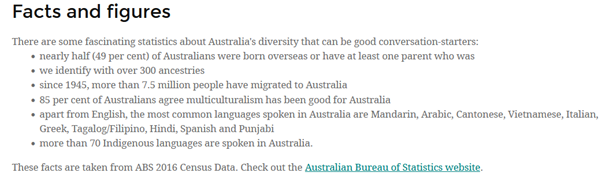
How is your management team represent the 49% of people born abroad? How does your board represent 7.5 million migrants since 1945? How does the management team represent the POC public or clients is serves?
Are People of Colour only good on the ground, but not good enough to manage?
Why is it that PoC must work twice as hard to be considered half as good?
Yet PoC continue to give our all and contribute to this land that we call home, despite suffering the daily microaggressions that eat away at us, but seemingly go unnoticed or unregarded.
For the non PoCs reading this article, microaggressions are the seemingly small, seemingly harmless mistakes, jokes, and inconsiderations that are directed at PoCs every day. They are perceived by us as one would receive small cuts with a knife. They happen multiple times a day and by the end of each day leave us exhausted and emotionally battered.
A few examples:
Often I get into a lift at work wearing my usual three piece suit only to see women clutch their handbags a little tighter or have men clench their fist in anticipation of trouble.
How many times as a Black man have I been subjected to the salutations “man” when others are greeted with their name or as “mate. This forced familiarity undermines our position in a group setting, and sets us apart as non equal. Even in a social setting, this term implies an informality that often does not exist upon first meeting, and invites others when listening to our opinions to take them less seriously or even worse, in jest.
“Where are you really from?” is a phrase I hear both in and out of working environments. It is as if people have difficulty believing their own ears as I tell them that I am from London, with a thick Eastend accent. Or perhaps it is their eyes that they can not believe, as they try to comprehend the juxtaposition of a Black man being from London, and not some “exotic” Caribbean island or the “wild and fearsome” Africas.
“Your English is really good, I am surprised”. Why are you surprised, I am English, what language were you expecting from my mouth. I also have people make assumptions about my language, as the slow down their sentences and speak very slowly, supposedly for my benefit.
Stereotypes both in and out of working environments slowly chip away at our resilience “ you must be good at maths” , “You must be good at dancing, come show us how it is done”, “Can you eat your food somewhere else? Staff are complaining that it smells spicy” etc.
“N” word in songs is not acceptable at the best of times, let alone at work as background music, xmas party music, or in the gym.
There is a perception that Black/POC not allowed to be angry within a work environment. When white people do it, they are “letting off some steam”, or “having a moment”, however when black people do it we are “overly aggressive”, “an angry black man/woman” and the next steps normally involve unrequired HR involvement and anger management programmes.
As a Person of Colour how often have you heard “Be patient”, “change takes time”, Change does not happen overnight”, “Political correctness gone mad” etc. All these phrases imply that we should sit and wait patiently as the oppressor continues to apply racially motivated pressure within the work environment. You have your foot on my neck, yet you want me to be patient, and say please.
“I do not see colour” really, then that is the problem. As by not seeing colour, you do not see the generations of inequity that have now put us in the same room. You are ignoring conscious and unconscious bias that that People of Colour wade through every day. We are encouraged to “bring our whole selves to work” but any PoC that says that they are is lying. We are expected to bring our ‘received’ selves to work, anything else is considered overpowering, overbearing or even threatening.
I worked with an organisation that set up a Anti Racism group. However the People of Colour who joined the group were expected to teach the white people, and to share their traumas and microaggressions so that the white members of the group could learn.
A People of Colour Committee (PoCC )was quickly developed as a safe place for PoCs to exist in a safe space, to share their race based issues from the organisation, and act as a support group to each other.
As expected, the Anti Racism group quickly withered and died, but the PoCC carried on strong and grew with more PoC members, who were now able to advocate for the PoCs in the organisation and advice on any relevant external advocacy.
The PoCC set up a strategy, Vision, Mission, and member rules. Before long it was advocating for policy changes within the organisation that would protect its members and the People of Colour that it served within the community.
One of the objectives of the PoCC became the engine that drove inward and outward facing policies and advocacy that effected People of Colour. After all, how can an organisation have policies that effect People of Colour, without consulting People of Colour.
May companies, particularly in Australia claim to be diverse. But diversity of thought of not enough, actual diversity is required, and this applies at ALL levels of an organisation.
Diversity does not mean different types of white.
With the working environment, as it is within social settings, it is not enough to be Not Racist, being Anti Racist is the benchmark.
So, on this International Day for the Elimination of Racial Discrimination, what can we all do.

 The Black Caucus