Hello, and welcome to the Black Caucus–Australia website.
The purpose of the Black Caucus is to be a voice for Black people, by Black people on all topics, both abroad and in Australia.
The Black Caucus is a not for profit organisation designed as a social commentator to speak on political issues, academic debate, and news.
The Black Caucus–Australia is not only limited to the advance of black people in Australia. We comment on how the events around the world will impact on Black people in Australia.
Black Caucus also functions as a ‘think tank’, and as such does not focus on membership, but on the editorial contributions made by our community.
Please check this BlackCaucus.com.au website for updates that may affect you.
Also please check out our X (Twitter) @BlackCaucusAus for more day to day commentary on issues that not only affect Black people directly, but all culture as a global community.
The Black Caucus is proud to have a representative on the Victorian Multicultural Commission’s North West Regional Advisory Committee (RAC).
In this second quarter, the RAC took on the topics Racial Discrimination, Healthcare, Education, and our expectations of the VMC and our interactions and expectations of the organization.
Racial Discrimination – 01.08.24
Culturally appropriate meals on wheels.
Loosing hours on SBS.
Racism in the workplace.
Language differences.
Talking about food.
Racial discrimination in the work place.
Exploitation.
Pacific workers are heavy lifters – more than 30kg.
No safety net for casual workers not from here.
Interpreters and translators in the workplace.
Employer assisted programmes to include English language lessons.
Racial discrimination in the sporting space.
Racial discrimination during employment.
System in place where value is the driver rather than network.
Transparency on tender processes.
English as a discrimination tool in interviews
People from abroad may not have local business knowledge
Discrimination through references.
Equal opportunities.
Contracts that they are being signed to.
Shortlist.
EBAs that adjust for a migrant wok force.
Diversity up to the middle ranks, but none at the senior and upper management
Blind employment process.
Racial discrimination through names on a CV.
Gain access into the country based on skills, but then skilled opportunities are not available.
Economic hardship tends to exacerbate racial discrimination in the workplace.
Overqualified as skilled migrants.
Teaching standards
Commit to the campaign
Seniors in home and cultural food.
Age discrimination.
—-
Bring the community together – With help from the government with resources.
Interpretation and translation upskilling – Utilise our languages.
Interpreter and translators on site.
Material in the language of the employees
VMC to raise awareness of racial discrimination and influence
Intercultural relevance in sporting bodies.
VMC to influence the Age department and DHSS from a racial lens.
Overseeing body to monitor racial mix of organisations.
Strengthening anti discrimination laws.
Racial discrimination of the police – Highlight the gangs.
State government could “shadow shop” the employment market to see whether
Healthcare – 02.09.24
Tasks
1. Census ethnic representation reinstated. VMC to lobby on our behalf
2. Mandatory healthcare representation at festivals as a criteria for government funding.
3. Funding at local levels in schools, clubs, community organisations. Bottom up approach to needs.
4. Employment pathways. VMC to lead advocacy.
5. Funding bias beyond festivals into community programmes
6. Consular support advertised as a mental health option
7. Celebrating good mental health programmes and success stories through mental health awards. Funded through VMC et al.
.
Health literacy – Language service – Targeted assistance – Including multicultural experience in healthcare – Stigma – Racism in health structures = Health services responding to changing communities – Funding ad focus – Improvement to language services – increase awareness of language service – multicultural communities represented in the workforce – Health work force – Training pathways – Invites a speaker from Refugee Health and Community health – Existing structures/partnerships
.
Hospital access to interpreters, Stigma, Health seeking behaviours, Action accessing healthcares = Skilled worker who can not work in Australia act as health translators – Intersections of work – Adverts translated into other languages – Cultural understanding. – Funding to community networks.
.
Increase in chronic healthcare, Rising cost – Waiting periods = Government intervention on these serves, giving proper direction, wait times to be reduced
.
Hard to get what you need – waiting times – Interpreter – language barriers – You have to know the system – Stigma = Open a big facility multicultural assistance Navigators – Teach you how to use the system
.
Decisions are not being made by the people in the waiting rooms
Representation in the decision making process = More POC representative, proactive recruitment – proactive training – VMC resources being depleted,
Education – 01.10.24
International students
Qualified teachers in the community
Looking in the wrong places\
Visa situation
International students to teach
Visa teaching pathway
Retires as teachers
.
Women are late to education
Defined by their parents
Priorities shift in 40s
Short courses – Pathway to a job
Access
.
Supporting of international students – teaching as a pathway to residency
Recognition of overseas learning
Removal of red tape
Short courses
Concession learning without a concession card – eligibility for courses
Process after education – Support in the communities
Promotion and distribution
Access to English education – Review of existing programmes are required
List of employers that have links into the POC communities
Safe work places list
.
Educating a woman is educating a family and a nation
Basic understanding of English
Sliding scale of English requirement
The hidden cost of education
CV making
Support and guidance
.
Mentors are a very important point. AIM, one of the organisations I’m part of, has a mentoring program that I’ve been part of as a mentor to international students in my community helping with course topics and especially on CV, interviews and ‘how to get a job’ post course completion. Although individual communities are working on this.
This should be readily available in our communities in Victoria.
.
Part qualified
How short courses are perceived in the market
.
*My support/comments for short courses (are things like Forklift Licence, Traffic Management, White Card, HR/MR licencing*
.
Placement of students – Government assistance to place students
Women’s Family cost of education – Baby sitting, Food preparation. – Subsidies
.
VMC support on how to activate our communities to be empowered to make real changes to law
.
International student concessions – Transport, ID cards, Children on international students fees -Special needs funds are unavailable – parents afraid of diagnosing their children for fear of visa rejection.
.
Educational administrator with PoC backgrounds Principles and Vic Principles
.
Parents who may not have confident English
Industry sponsoring bright minds
VMC advocating to Industry
.
We arrange interpreters to join Parent/Teacher meetings. There is free interpretation and translation service from Language Loop for state schools.
.
VMC advocating Mentoring around how industry works in Australia.
.
Paid placements, Travel costs, subsidies lunch.
.
NDIS provider numbers in education
RAC expectations of the VMC
SLA – Expected turn around and response times for RAC queries, submitted documentation, requests and progress.
VMC supposed to be the “conduit between the community and the minister and their office.” Vivianne Nguyen.
RAC does not see the results of its contribution.
Community Priorities missed – Census ethnic representation reinstated. VMC to lobby on our behalf
Paul’s Employment paper was unacknowledged and unanswered
VMC should make data and statistics available to the RAC members so they may better inform their communities, as well as better focusing our RAC discussions.
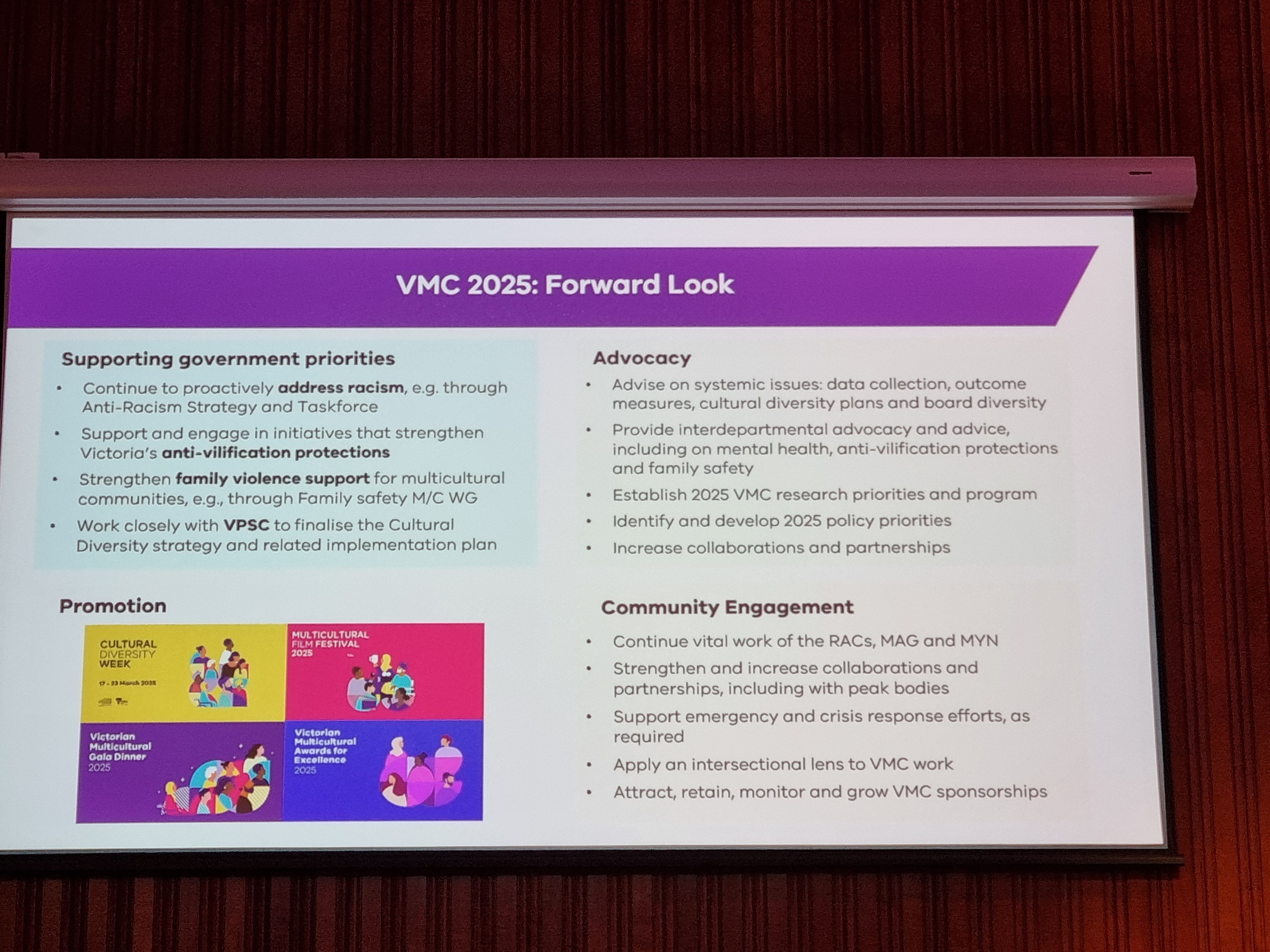
At the End of Year presentation the VMC shared their objectives for 2025. We not that the advocacy mentions data collection and trust that the RAC priorities are included.
We are reposting this article, originally posted on 23.05.23 after enduring the Melbourne United post game arena music on 20.10.24 and 27.10.24, as well as another complaint we made to the management of Derrimut Gym in Braybrook on 29.10.24.
I enjoy all kinds of “Black” or “Urban” music as it is now called.
I am not a prude, and I understand that the music of my generation introduced the ‘N’ word into mainstream society, through bands like NWA, Snoop Dog, Tupac, Notorious BIG, etc.
I understand that the genie is out of the bottle, and that the ‘N’ word has become a rhyming tool that is used by all the modern rappers, some of whom I enjoy. Kendrick Lamar, Childish Gambino and the like.
In the right environment, and amongst the right people, I have no objection to these lyrics, and where as I do not use the ‘N’ myself, I believe in the continued nuanced conversation about its use among black people.
In Australia I am encouraged by the increasing use of Black music as an incidental backdrop found in shops, restaurants, tv advertisements. However, a few situations have recently given me pause.
In the light of the rise of Nazis in Australia and the emboldened push from racists and the far right, I have found myself being more aware of my surroundings and attuned to potential dangers.
Over the past year I have noticed my gym is playing rap music that is almost entirely composed of the ‘N’ word. Amongst the right demographic this would not necessarily be a problem, however my gym is predominately made up of Asian and White people, which makes the use of this word blasted over the gym speakers unacceptable to me and the other Black patrons. I have spoken to the staff behind the counter, and written to the management of the gym, but have not received a response.
Last new years eve, I was in an expensive restaurant with my partner when the restaurant playlist started playing ‘N’ word songs that I similarly consider inappropriate for that setting. The only other Black couple in the restaurant were clearly also uncomfortable, so once again I approached the manager to discuss the playlist. This time I was brushed aside with excuses about it not being their playlist and them having no alternatives.
I think that there needs to be an awareness of the music that is being played in a public environment.
It would be considered unacceptable to play misogynist or sexist songs that made their female patrons uncomfortable, yet it seems acceptable to blast black racial slurs at decibels that are audibly comfortable in public places.
Jewish, Indian, Pakistani, Chinese, or Mexican slurs would not be tolerated, not only by their communities, but by polite society, and would be instantly removed. So what is the difference with music that uses Black slurs and denigrates Black culture and people?
The use of these songs in public places encourages non blacks to openly and loudly sing along to inflammatory ‘N’ word lyrics that will insight violence if heard by a conscientious Black person.
Legally the ‘N’ word along with a combination of lyrics and situational context is an “incitement to racial hatred”.
I have been on a bus where white people were singing along to rap song containing the ‘N’ word, and I was forced to approach then and make my displeasure known.
I often find myself turning down or changing my music in the summer, when driving through predominately white neighbourhoods, because I do not want white people to feel encouraged on the use of the ‘N’ word because it is endorsed through my car speakers.
So what is the answer? How to we approach the inequality of unacceptable language? How do we stop the use of Black racial slurs in public places by non white individuals and corporations?
The Black Caucus is pleased to have contributed to the Victoria Multicultural Commission’s Regional Advisory Committees, and lead the four sub committees on Family Violence, Mental Health, Employment and Housing.
Under Family Violence we discussed:
Elder abuse – Children wanting to get there inheritance early. – Elders feeling obligated to their children who look after them. Learned behaviour. Abuse of female in the family. Family violence is not just physical, language. Same sex violence. Perpetrator behavioural correction. Cultural competency. Elders without support. Family breakdown. Men do not report family violence. Family do not report the problems they see. The effects of Prison. Knowing what to look for within schools. Intervention orders – lack of accountability for the perpetrator. Understanding the measures available. Training community champions who are culturally aware. Prevention intervention. Schools and adults – need funding. Emotional awareness – be careful with words – Listen. Those unable to share. Community with the wrong information. Afraid families will be taken away. Afraid visas will be taken away. Agencies like – Orange door – In Touch. Family violence that spills out beyond the family. Only get help if you ask for help. Family members asking for help do not get the help. A day where all social service come together so we can learn off each other. – Need funding. Find our answers amongst ourselves – within the multicultural community. – Need funding. International Day for the Elimination of Racial Discrimination. Not all communities are treated equally – police – media – etc. Community representation or elder support when police present at family violence incidents.
The Mental Health discussion created seven tasks for the VMC to action:
1. Census ethnic representation reinstated. VMC to lobby on our behalf.
2. Mandatory healthcare representation at festivals as a criteria for government funding. 3. Funding at local levels in schools, clubs, community organisations. Bottom up approach to needs.
4. Employment pathways. VMC to lead advocacy.
5. Funding bias beyond festivals into community programmes.
6. Consular support advertised as a mental health option.
7. Celebrating good mental health programmes and success stories through mental health awards. Funded through VMC et al.
The Housing sub committee discussed:
References availability for new migrants.
New Migrants – Cernterlink – Lower income.
Credit references for migrants.
Visa status – prejudice.
Government analysis of the data.
Rebate guarantee to landlords renting to new migrants.
Handing your house to the council to manage – UK model.
Converted container housing as a temporary / medium term option.
Discrimination against large families.
Migrants unaware of rental rights Minimal standards.
Cheatsheets for finding housing.
Standardised blind applications.
Standards of heating
Intersectional discrimination.
Preplanning before arrival in Australia Migrants resource centres.
Journey of the migrant guide or booklet with a checklist.
Comic strips for communication.
Family pressures on people staying with them Pressure and financial burden on host family .
Aid refugees to be self sufficient.
Fix it Friday.
Standardisation of housing facilities.
Advocacy.
Temporary housing has a knock on effect on children.
Migrants being chased away by landlords. The further use of hotel accommodation as an extended medium term solution.
On 21 March 1960, police in South Africa gunned down 69 unarmed Black South African people protesting against the pass laws in an event that became knows as the Sharpeville massacre.
Six years later, the United Nations created the International Day for the Elimination of Racial Discrimination on that date.
In 1998, Australian Prime Minister commissioned the Eureka Research to begin an anti-racism study to “explore and understand the subtleties and nature of racism in the Australia of the late 1990s, with a view to mounting an effective mass media and/or education anti-racism campaign”.
Among the conclusions of the study were that there was a need for an anti-racism campaign and a promotion of “living in harmony”. According to multiple media reports, the outcomes of the research were not aligned with the government’s views that Australians were not racist. Commenting on the racially-motivated 2005 Cronulla riots, he stated: “I do not accept that there is underlying racism in this country”.
The Eureka report was suppressed from public access until 2011.
In 2003, the Government of Western Australia renamed the event Harmony Week in that state, always celebrated in the same week: “celebrations from 15 to 20 March, followed by a day of reflection on 21 March”.
The event was renamed as Harmony Week by the government for its 20th anniversary in 2019, “to recognise diversity and inclusion activities that take place during the entire week.
When we compare the UNs web page and the Australian government page, we see how issues on racial discrimination and People of Colour (PoC) experiences are “white washed” into a more palatable narrative.
But they are not alone.
This white washing occurs in companies and offices across Australia and here, in Victoria.
The PoC experience is one that is ignored by most companies because it is considered “Too hard.”
Too hard to ensure that PoC feel included in their work environment.
Too hard to learn about the cultural differences that would streamline your working environment.
Too hard for the dominant culture to learn the fundamentals of the cultures that we wear to work on our faces, in our language and in our food, every day.
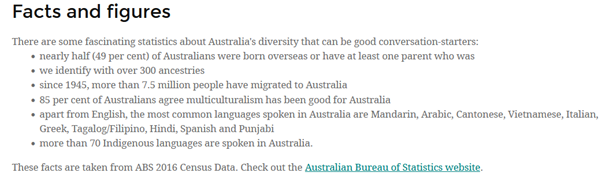
How is your management team represent the 49% of people born abroad? How does your board represent 7.5 million migrants since 1945? How does the management team represent the POC public or clients is serves?
Are People of Colour only good on the ground, but not good enough to manage?
Why is it that PoC must work twice as hard to be considered half as good?
Yet PoC continue to give our all and contribute to this land that we call home, despite suffering the daily microaggressions that eat away at us, but seemingly go unnoticed or unregarded.
For the non PoCs reading this article, microaggressions are the seemingly small, seemingly harmless mistakes, jokes, and inconsiderations that are directed at PoCs every day. They are perceived by us as one would receive small cuts with a knife. They happen multiple times a day and by the end of each day leave us exhausted and emotionally battered.
A few examples:
Often I get into a lift at work wearing my usual three piece suit only to see women clutch their handbags a little tighter or have men clench their fist in anticipation of trouble.
How many times as a Black man have I been subjected to the salutations “man” when others are greeted with their name or as “mate. This forced familiarity undermines our position in a group setting, and sets us apart as non equal. Even in a social setting, this term implies an informality that often does not exist upon first meeting, and invites others when listening to our opinions to take them less seriously or even worse, in jest.
“Where are you really from?” is a phrase I hear both in and out of working environments. It is as if people have difficulty believing their own ears as I tell them that I am from London, with a thick Eastend accent. Or perhaps it is their eyes that they can not believe, as they try to comprehend the juxtaposition of a Black man being from London, and not some “exotic” Caribbean island or the “wild and fearsome” Africas.
“Your English is really good, I am surprised”. Why are you surprised, I am English, what language were you expecting from my mouth. I also have people make assumptions about my language, as the slow down their sentences and speak very slowly, supposedly for my benefit.
Stereotypes both in and out of working environments slowly chip away at our resilience “ you must be good at maths” , “You must be good at dancing, come show us how it is done”, “Can you eat your food somewhere else? Staff are complaining that it smells spicy” etc.
“N” word in songs is not acceptable at the best of times, let alone at work as background music, xmas party music, or in the gym.
There is a perception that Black/POC not allowed to be angry within a work environment. When white people do it, they are “letting off some steam”, or “having a moment”, however when black people do it we are “overly aggressive”, “an angry black man/woman” and the next steps normally involve unrequired HR involvement and anger management programmes.
As a Person of Colour how often have you heard “Be patient”, “change takes time”, Change does not happen overnight”, “Political correctness gone mad” etc. All these phrases imply that we should sit and wait patiently as the oppressor continues to apply racially motivated pressure within the work environment. You have your foot on my neck, yet you want me to be patient, and say please.
“I do not see colour” really, then that is the problem. As by not seeing colour, you do not see the generations of inequity that have now put us in the same room. You are ignoring conscious and unconscious bias that that People of Colour wade through every day. We are encouraged to “bring our whole selves to work” but any PoC that says that they are is lying. We are expected to bring our ‘received’ selves to work, anything else is considered overpowering, overbearing or even threatening.
I worked with an organisation that set up a Anti Racism group. However the People of Colour who joined the group were expected to teach the white people, and to share their traumas and microaggressions so that the white members of the group could learn.
A People of Colour Committee (PoCC )was quickly developed as a safe place for PoCs to exist in a safe space, to share their race based issues from the organisation, and act as a support group to each other.
As expected, the Anti Racism group quickly withered and died, but the PoCC carried on strong and grew with more PoC members, who were now able to advocate for the PoCs in the organisation and advice on any relevant external advocacy.
The PoCC set up a strategy, Vision, Mission, and member rules. Before long it was advocating for policy changes within the organisation that would protect its members and the People of Colour that it served within the community.
One of the objectives of the PoCC became the engine that drove inward and outward facing policies and advocacy that effected People of Colour. After all, how can an organisation have policies that effect People of Colour, without consulting People of Colour.
May companies, particularly in Australia claim to be diverse. But diversity of thought of not enough, actual diversity is required, and this applies at ALL levels of an organisation.
Diversity does not mean different types of white.
With the working environment, as it is within social settings, it is not enough to be Not Racist, being Anti Racist is the benchmark.
So, on this International Day for the Elimination of Racial Discrimination, what can we all do.
The Black Caucus is once again delighted to announce the appointment of a representative to the Victorian Multicultural Commission’s Regional Advisory Council from 2024.
The Black Caucus became involved with the VMC in 2014 and served on the council from 2017 to 2020 where we discussed the needs of communities of colour and contributed to a report submitted to the minister via the Victorian Multicultural Commission.
The Black Caucus also provided a calming influence on the ‘African Gangs Police Task Force’ by reinforcing community solutions, highlighting the lower ratio of crime compared to other demographics, and raising the concerns of police arrest quotas.
The 2024 appointment is an opportunity for The Black Caucus to further represent its members and the broader community on issues that are important to us all.
The Victorian Multicultural Commission (VMC) established eight Regional Advisory Councils across the state in 2012. The role of the Regional Advisory Councils are to:
Inform the Commission about issues and challenges impacting multicultural communities in their region.
Keep the Commission abreast on matters of multicultural affairs, settlement, access to services and citizenships issues, including equitable outcomes for multicultural communities.
Assist the Commission in its commitment to multicultural affairs in the local regions, including promoting the benefits of cultural, linguistic and religious diversity.
Identify potential pathways and opportunities for participation and connecting communities, activities and events to strengthen community capacity.
Three Regional Advisory Councils are based in Melbourne and surrounds – Eastern Metropolitan, North & West Metropolitan and Southern Metropolitan – and five are based in rural and regional Victoria – Baron South West, Hume, Loddon Mallee, Gippsland and Grampians. Each Regional Advisory Council is comprised of:
local community members;
local service providers delivering services to migrant and multicultural communities;
local business and community representatives; and
local government representatives.
If you have any issues that you wish to raise, and you would like your voice heard, contact us at The Black Caucus.
I like this theme. It pays respect to the tireless First Nation’s leaders who have done so much to improve the lives of their people.
For NAIDOC week this year, I’d like to pay my respects to & celebrate two female elders from Tasmania. One elder is from the past, and one is from the present.
I pay my respects to Truganini, whose country was Bruny Island, part of the south-east Nation in Tasmania. Truganini survived decades of abuse, violence and incarceration in the 19th century in Tasmania. Despite the loss of her country, her freedom, her family, and almost all of her people at the hands of colonisers she survived into her 60’s to be an elder, an educator for her people’s children. She helped keep their culture and language alive in Tasmania. Her incredible story (I can recommend reading ‘Truganini, Journey Through The Apocalypse’ by Cassandra Pybus) of courage, resilience and survival is one we don’t talk about anywhere near enough. We should be recognising and celebrating her life as we do other great Australian survival stories.
After reading Thomas Mayor’s brilliant book ‘Finding The Heart Of The Nation’ I was made aware of many female elders in Australia today who are working hard to improve the lives of their people. I pay my respects in particular to Darlene Mansell, a Pakana woman from northern Tasmania. Darlene has been driving several health & legal improvement initiatives in Tasmania. Darlene is helping keep her culture and language alive in northern Tasmania. Darlene is also a leading activist for indigenous and women’s rights in Tasmania and Australia. Darlene is an important female voice in the constitutional reform dialogues and is one of many First Nation women ensuring the female voice is included in these important political discussions that will shape how the ‘Uluru Statement from the Heart’ will be brought to life, starting with the referendum on ‘voice to parliament’ later this year. Darlene’s dream is for her grand-child to one day be elected as the ‘voice’ representative for her Pakana people.
#NAIDOC2023 #ForOurEldersNote: National NAIDOC Week celebrations are held across Australia in the first week of July each year (Sunday to Sunday), to celebrate and recognise the history, culture and achievements of Aboriginal and Torres Strait Islander peoples. NAIDOC Week is an opportunity for all Australians to learn about First Nations cultures and histories and participate in celebrations of the oldest, continuous living cultures on earth. You can support and get to know your local Aboriginal and/or Torres Strait Islander communities through activities and events held across the country.
My NAIDOC hero and inspiration is William Cooper. Cooper was a Yorta Yorta man (from northern Victoria around the yarra river), an Aboriginal activist and a human rights advocate in the early 20th century. He was the founder of the Australian Aborigines League and he is also known as the Father of the National Aboriginal and Islander Day Observance Committee (NAIDOC), the annual event we are celebrating this week.
In the course of demanding the rights of citizenship and “uplift”, Cooper repeatedly sought to draw attention to his ancestors’ prior ownership of the land and their subsequent dispossession, displacement and decimation.
The successful 1967 Commonwealth referendum, which finally changed the Constitution so that like all other Australians, Aboriginal and Torres Strait Islander peoples would be counted as part of the population and the Commonwealth would be able to make laws for them, wouldn’t have happened without leaders like Cooper demanding & fighting for change from as far back as late 19th century. 90.77% of voters voted in favour of the ‘Constitution Alteration (Aboriginals) 1967’, which was the highest ‘yes’ vote ever recorded in a federal referendum.
William Cooper inspires me to be patient and never give up on demanding reformative change. E.g. never tire in playing my role to help the first nations people of Australia achieve the objectives of the Uluru Statement of the Heart.
I enjoy all kinds of “Black” or “Urban” music as it is now called.
I am not a prude, and I understand that the music of my generation introduced the ‘N’ word into mainstream society, through bands like NWA, Snoop Dog, Tupac, Notorious BIG, etc.
I understand that the genie is out of the bottle, and that the ‘N’ word has become a rhyming tool that is used by all the modern rappers, some of whom I enjoy. Kendrick Lamar, Childish Gambino and the like.
In the right environment, and amongst the right people, I have no objection to these lyrics, and where as I do not use the ‘N’ myself, I believe in the continued nuanced conversation about its use among black people.
In Australia I am encouraged by the increasing use of Black music as an incidental backdrop found in shops, restaurants, tv advertisements. However, a few situations have recently given me pause.
In the light of the rise of Nazis in Australia and the emboldened push from racists and the far right, I have found myself being more aware of my surroundings and attuned to potential dangers.
Over the past year I have noticed my gym is playing rap music that is almost entirely composed of the ‘N’ word. Amongst the right demographic this would not necessarily be a problem, however my gym is predominately made up of Asian and White people, which makes the use of this word blasted over the gym speakers unacceptable to me and the other Black patrons. I have spoken to the staff behind the counter, and written to the management of the gym, but have not received a response.
Last new years eve, I was in an expensive restaurant with my partner when the restaurant playlist started playing ‘N’ word songs that I similarly consider inappropriate for that setting. The only other Black couple in the restaurant were clearly also uncomfortable, so once again I approached the manager to discuss the playlist. This time I was brushed aside with excuses about it not being their playlist and them having no alternatives.
I think that there needs to be an awareness of the music that is being played in a public environment.
It would be considered unacceptable to play misogynist or sexist songs that made their female patrons uncomfortable, yet it seems acceptable to blast black racial slurs at decibels that are audibly comfortable in public places.
Jewish, Indian, Pakistani, Chinese, or Mexican slurs would not be tolerated, not only by their communities, but by polite society, and would be instantly removed. So what is the difference with music that uses Black slurs and denigrates Black culture and people?
The use of these songs in public places encourages non blacks to openly and loudly sing along to inflammatory ‘N’ word lyrics that will insight violence if heard by a conscientious Black person.
Legally the ‘N’ word along with a combination of lyrics and situational context is an “incitement to racial hatred”.
I have been on a bus where white people were singing along to rap song containing the ‘N’ word, and I was forced to approach then and make my displeasure known.
I often find myself turning down or changing my music in the summer, when driving through predominately white neighbourhoods, because I do not want white people to feel encouraged on the use of the ‘N’ word because it is endorsed through my car speakers.
So what is the answer? How to we approach the inequality of unacceptable language? How do we stop the use of Black racial slurs in public places by non white individuals and corporations?
The Black Caucus was represented at ‘Light supper with Minister for Multicultural Affairs, Robin Scott MP’ in Tarneit.
The audience was made up almost entirely of West Africans and Indians, both young and old, all migrants to Australia and potentially, all allies as people of colour (POCs) in the battle for equal recognition in a white dominated black country.
However, towards the end of the evening, an Indian community member was suggesting to the minister that education on obeying law and order should be mandatory to migrants in order to curtail a perceived rise in violence. The implication was that perpetrators of these crimes and the recipients of these lessons would be the African communities.
“These people need to be taught that violence is not acceptable in this country. They come over here and do not know how to behave.”
His comments suggested that African families allowed their children to run wild, without any understanding of the rule of law or discipline of any kind. His suggestion was that suddenly they get to Australia and do not know how to behave in polite society, despite being at the cradle of civilisation.
These comments were despite the fact that he was so obviously a migrant himself, and the implication that all of the crime was being carried out by the migrants from African countries, despite the evidence to the contrary provided by local and national police chiefs.
The minister made every effort to correct the man’s perceptions by stating that violence is unacceptable in any community and that teaching this to all children in schools would be a more appropriate solution to the overall general violence perpetrated upon society.
He was sat next to a Victorian Multicultural Commission Regional Advisory Member, who had previously voiced views that welfare should taken away from the black community as a whole, if members are found to commit crimes. In her eyes, everyone suffers for one person’s misdeeds.
As the evening drew to a close the minister’s aide asked for all those who were in the room to huddle around the minister for one collective photo. The Africans did as requested and the pictures were taken, however the Indians stood back, not wanting to associate, let alone be seen in a picture with the Africans. The minister was then whisked away, leaving the Indians angry and disappointed that they could not get their ‘Indians only’ picture.
The event was catered, and the room segregated once again with the Indians standing in one part of the room, and the Africans in another, seemingly nobody from either group wishing to discuss the issues that affect their communities and discuss the solutions collectively.
I wonder what it is that would put the Indian community at such odds with the Africans. Was it that the Indians felt themselves better educated than the Africans? Or was it the prominence of their caste system, so engrained in their culture, that they instinctively see Blacks as inferior? I think that there may be more to it, that in a society where recent migrants like Indians, Sri Lankans, Pakistanis and Africans are struggling, there is the potential to demonise the Africans in a way of ingratiating themselves with their white hosts. By creating a Black common enemy, the focus is no longer on them and they can prosper.
However, this is not the only community of colour swiping at the Africans.
Contacts in the Victorian Police have also noted an increase in friction between the Chinese/Asian community and the Blacks, not just Africans, but Aboriginal and Caribbean.
Reports of shop keepers shouting at Blacks, following them around shops and demanding money before service in circumstances where this is not the norm.
We have also received reports of increased passive aggressive behaviour, such as a deliberately not giving way on pavements even though they clearly see us approaching, preferring instead to charge into oncoming Blacks, a tactic seemingly not experienced by our white counterparts. This seems to be a minor aggression, until you find yourself constantly responsible for avoiding collisions on the street, and continually stepping into the road, whilst being gazed upon as a second class citizen.
I cannot deduce why this open disrespect is taking place, and I have researched Chinese culture specifically regarding this matter for quite some time for this article, still with no academic conclusion.
In the UK from the 40’s through to the 80’s, minority groups invited by the British government from British colonies to rebuild Britain after the war, were racially abused by the white British public, and harassed by the white police. At that time PoC communities united together to stand against racist policies that kept them in poor housing and menial jobs. This united front worked, and white British attitudes were slowly forced to change, moving a few steps closer to equal rights for all Britons.
I have seen PoC unity work, and lived this experience in the UK, which is why I was surprised to not see this same unity amongst the PoCs in Australia. Ethnic communities in Australia fall, as nothing more than divided minority groups, lacking the strength of numbers to directly impact policies and legislation. We are easy pickings for politicians, the media and white nationalists. While PoCs bicker amongst ourselves, white Australia simply sits back and waits for a weakened victor, one that they can then pacify and ignore.
Over recent years, it is generally accepted by law enforcement around the world that tackling the root of the problem vastly reduces crime, rather than incarceration.
In America, Reagan, Bush, and Clinton have gone on record to say that their policies of funding prisons to focus on punishment rather than rehabilitation were wrong. Obama has repeatedly espoused the virtues of fixing the employment and housing issues in America as the priority to lift the economic status of the poor, and reduce crime.
Social policing programmes have been instigated in the toughest parts of Glasgow and London, to better understand the lower socio-economic communities, and in each case these front liners have reported to government that raising the poor from poverty would stop economic crime.
In Australia, economic crime has been carried out by generations of migrants. Irish, Italians, Greeks, and Polish were organised but less subtle in the execution of crime, whereas the Chinese and Vietnamese have been more sophisticated, thus drawing less attention from the Police.
Europeans, Asians, Arabics alike have all been on the bottom of the economic ladder so why are Africans being treated differently? Is it because they stand out more than previous migrants? Is it because they are perceived as more physically threatening than those whom have come before?
The fact of the matter is that Africans, and by association, all Blacks in Australia are under attack from the media trying to sell bad news, politicians trying to rule through fear, and white Australia still wrestling with its genocidal past. Unfortunately where they expected to find allies, they have instead found disrespect and isolation. If you back anyone into a social and economic corner, and isolate them because of the selfish motives of a rising migrant middle class, what outcome would you expect? The fear is that the frustrations of the Africans will boil over into violence. Why would you not try to remove the fuel of social, political and economic injustice that stoke the fire, rather that fan the flames with the hot air of media and political sensationalism, and pour on the gasoline exclusion from other communities of colour?
There is a storm coming. Do we all act together to dissipate the problem? Or do we all stand around blaming each other and wait for the inevitable devastation? How will you account for your words, your actions?


 The Black Caucus